In this article, we’ll cover five common yoga poses that can help you get started on your yoga journey. There’s much more poses than these to try, but these are good beginner ones to explore the world of yoga! Note that with all these poses it’s important to breath. Breathing allows your muscles to relax for a better stretch.
Pose 1: Downward Facing Dog
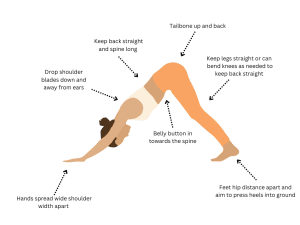
Muscles Targeted? Shoulders, triceps, upper back, abdominals, hip flexors, hamstrings, calves, glutes, quadriceps, forearms, wrist flexors, back, core.
How?
Step 1: Start on all fours on your hands and knees: hands slightly in front of shoulders and fingers wide.
Step 2: Tuck your toes: with feet hip-width apart, curl your toes.
Step 3: Lift knees off the floor: raise hips toward the ceiling while straightening your knees. Note if this movement is too difficult, you can bend your knees!
Step 4: Push hips back and up: While doing this, elongate spin and engage that core.
Step 5: Press heels on floor for a nice calf stretch. If your heels don’t touch the floor, don’t push it no worries, you’ll get that flexibility eventually!
Step 6: Relax neck and head: Look between your feet or belly button for a relaxed head posture.
Pose 2: Child’s Pose
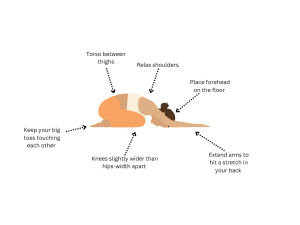
Muscles Targeted? Back, hips and thighs.
How?
Step 1: Start on all fours on your hands and knees.
Step 2: Spread your knees slightly wider than hips-width apart, or can even spread them as wide as your mat if your body allows.
Step 3: Face feet so the top is touching the floor and position your big toes so they touch each other.
Step 4: Have your stomach rest between your thighs, relax shoulders and place forehead on the floor.
Step 5: Extend arms in front of you to hit that stretch in your back as well.
Pose 3: Cat-Cow Pose
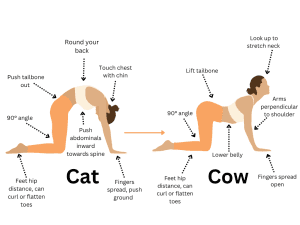
Muscles Targeted? Neck, shoulders and spine
How?
Start on hands and knee with knees underneath your hips and wrists underneath your shoulders.
Cat Pose
Step 1: Tuck in tailbone and tilt pelvis forward. This will allow your spine to curl upward.
Step 2: Drop your head by tucking your chin into your chest and gazing at your bellybutton.
Now, time to covert your cat pose to a cow pose…
Cow Pose
Step 1: Go back to the tabletop position with your hands and knees.
Step 2: Inhale and lift your tailbone up while aiming your belly towards the ground.
Step 3: Set your gaze upwards.
Go through these two motions for the desired amount of repetitions.
Pose 4: Standing Forward Fold
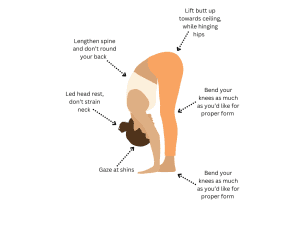
Muscles Targeted? hamstrings, calves, lower back and glutes
How?
Step 1: Stand tall (lengthening your spine) with feet hip-width apart.
Step 2: Inhale and raise your arms overhead.
Step 3: Exhale and most importantly, bend from your hips to fold forward. You can choose to keep a bend in your knees if your hamstrings feel tight.
Step 4: Reach to the floor as much as you can, allowing your head and neck to relax. Ideally, the top of your head is parallel with the floor.
Pose 5: Bridge Pose
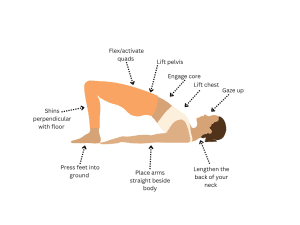
Muscles Targeted? Glutes, hamstrings, core, hip flexors and quads.
How?
Step 1: Lie on your back and bend your knees, with your feet flat on the floor and hip-width apart.
Step 2: Place your arms alongside your body, palms facing down.
Step 3: Engage your core.
Step 4: Inhale and lift your hips up. Note to not use your lower back for this and to engage the muscles in your body for support, most importantly hamstrings and core.
Step 5: Be careful not to put weight on your neck using your arms and shoulders instead as support.
Step 6: Breath for desired amount (but 10 seconds is good) and then release gently to come out of pose.
Rehash
- Downward Facing Dog
- Child’s Pose
- Cat-Cow Pose
- Seated Forward Fold
- Bridge Pose
Article FAQ
No. Yoga is not about “no pain, no gain.” If you feel pain while doing a stretch or pose, stop or modify the movement immediately. Yoga should feel challenging but never painful.
Think of breathing like lubricant for your muscles. Breathing helps your muscles to relax, allowing for a deeper stretch. Tense muscles make it harder (and less safe) to stretch.
Your body works like a machine. If one part isn’t optimal this can downstream affect other parts. Take this common example. Tight hamstrings can cause lower back pain because they pull on back muscles. Stretching your whole body ensures balanced flexibility and reduced strain!
Foam rolling! Incorporating this into your routine can improve circulation to your muscles and break up tight muscle knots thus improving flexibility.
If these yoga poses don’t agree with your body right now, you can use props like blocks, straps or bands to lessen the depth of the stretch. This is important because you don’t want to push your body to pain!