Introduction: No One Gives You the Playbook for Getting Your First Job After College
We’re mistakenly led to believe that once you have that degree in hand, the job opportunities come flooding in. College promises your whole future but doesn’t actually give you the playbook for how to achieve it.
Landing your first job after college isn’t the smooth, glamorous rite of passage many imagine when they toss their graduation cap and look at their school campus for the last time.
No one tells you about the hours you’ll spend perfecting that resume only to upload it into a system that forces you to retype everything again. Or how many times you’ll be ghosted and downright rejected by company after company.
And no one hands you the playbook for how to navigate this all. Well no more. At Quarter Life Co., we went through this exact thing, graduating during the COVID pandemic and swimming through rejection after rejection in hopes of landing a new grad job. After that experience, and subsequent rejections, as well as successes in landing new jobs, we’ve compiled a full playbook of how to get that first job out college. So you can get on the road to adulthood, with a job in hand.
Why Your First Job After College Is the Hardest to Get
You Have Limited Experience
Struggling to get that first job out of college is super common. The resume optimizations, ego blows from the constant rejections, and hundreds of times you’ll upload your resume, only to put all that info into a text box again is supremely frustrating.
You have to understand though, coming out of college, you have limited experience, real skills, or perspective of the working world. You may think that after completing 4 years of your degree, you’re now qualified to tackle corporate America head on, but the working world is a totally different animal than the college years you’ve experienced.
The Working World Is Nothing Like College
Because of this, you’re a risky hire to companies. Hiring and firing is one of the most expensive costs to a company, and because your resume doesn’t have any true data points of how you’d fare in a full time job, it makes companies less keen on hiring a new grad. The direct costs of replacing an employee can range from 50% to 200% of their annual salary. This coupled with the fact that when job markets are bad, you’re now competing with individuals with work experience for these entry level positions, stacks the odds evermore against you.
Stop Searching For Your “Dream Job,” It Doesn’t Exist Yet
You Don’t Even Know What You Want Yet (And That’s Normal)
It’s easy to feel that after putting up with 4 years of college, and the grind that can follow that, you paid your dues and you now deserve that dream job.
I’m here to tell you that getting your dream job out of college is next to impossible. In fact, you likely don’t even accurately know what your dream job is, since you’ve never even worked a full time role yet.
Being Picky Can Stall Your Entire Career
Being picky can cost you in the long run. I’ve seen several friends who stayed in the job market for months on months looking for the perfect job out of college, even though they got previous offers. But don’t overthink this. That first job, even if it’s not exactly what you want to do, will teach you so many skills and give you insanely valuable perspective, not to mention the paycheck that comes along with it.
Your First Job Is a Launchpad, Not Your Whole Future
And that first job isn’t your life. Even if it sucks, it’s temporary. And it’ll teach you so many valuable skills and perspective that will make picking your 2nd job even better.
My first job out of college was an engineering role. I got my degree in engineering so figured I’d be an engineer for my career. But then I realized I actually didn’t like the engineering side of things as much as I thought, because college can only expose you to so much of what the real world of your future career offers. But the engineering part aside, I learned so much from that job. Like what kind of bosses I work well with, what my strengths and weakness are, the work culture I want to be in, and I even met sales engineers who inspired me to pursue the path of sales instead. This all made looking for my 2nd job much easier. With my first job, I had no clue what I wanted, but with the 2nd job I could pin point better what I was looking for exactly. That is invaluable and that’s how you eventually find your dream job.
Cold Applying Doesn’t Work Anymore
How I Actually Got Every Job I’ve Ever Had
If you’re only applying online, you’re doing yourself a massive disservice. Most jobs aren’t going to come from cold online applying. Out of all the jobs I’ve had, I’ve never got it from cold applying online. My first 3 internships were from mentors, my Amazon internship was from a recruiter reaching out on LinkedIn, my full-time Amazon job was from my success in that Amazon internship, my tech sales job was from the connection through my Venture For America fellowship, and with the Peace Corps I reached out to a recruiter before I applied.
The point is, cold applying in this day and age is a failing strategy. At least 80% of all jobs, are filled through a professional network connection. Not a cold apply online.
Connections Are King
How you find a job now is through connections. That’s the plain truth. It may or may not be fair, but the old saying “It’s not what you know, it’s who you know” is 100% accurate.
But…but…but I have no connections.
Then make those connections. A lot of jobs show who the hiring manager and recruiter is. After applying to the job, reach out to them to say you applied and highlight why you’re a good fit.
When I was applying to a sales position at a top tech company, I cold called the hiring manager and said this is why I’m a good fit, showcasing my results from previous work experience. From that, I got the interview and the eventual job offer. All from that cold call. 2 months before I had no connection to him, but through just reaching out through LinkedIn and finding his phone number with my sales skills, I was able to get in front of his face and show why I was a good fit for the role.
Look To Your Network for Job Referrals
Also dig deep into your network. One method is when you see a role you want to go for, see if any LinkedIn connections work at that company. If they do and you have a good enough connection with them, you can ask them for a possible referral. All the big companies use referral systems and it significantly increases the chances your resume will be seen. Most of the online applications you put out will never see a human eye, but an internal referral gives your application a fighting chance.
4 Myths That Are Holding Your Mindset Back
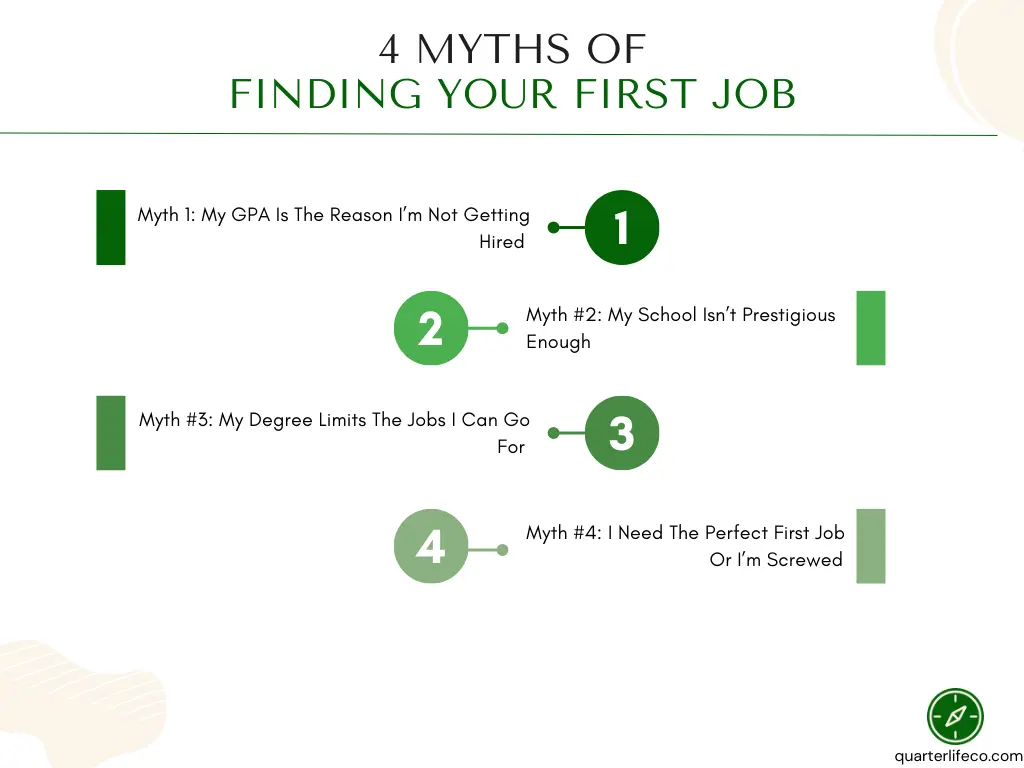
Myth #1: My GPA Is The Reason I’m Not Getting Hired
Here’s a surprising but freeing truth, after you graduate, almost no one cares about your GPA. Not hiring managers, not recruiters, not your future boss. As long as you meet that certain threshold, 3.0 for most companies and 3.5 for more top tier companies, the GPA is not what’s holding you back.
The only people who obsess over your GPA are grad school admissions officers, and Todd who peaked sophomore year.
Employers care more about skills, reliability, and someone who can be effective in that job. A GPA is not the best information to gauge that, and hiring managers know it. In engineering school, some of the smartest kids I knew who could seemingly build a car from scratch had terrible GPAs, but their abundance of real world projects landed them offers at incredible engineering companies.
So if your GPA is “bad”, stop using it as the crutch and show your real value, beyond the GPA.
Myth #2: My School Isn’t Prestigious Enough
Outside of the tippety topity schools, the “brand” name of your school does not matter. I really wish this myth was perpetuated less when high school seniors are picking between their affordable state school and the out of state private school that has slightly better rankings.
To add, this feels like a more chicken and the egg situation. Are those Ivy League grads seeing more success because they went to an Ivy League or it because they’re the type of person that can get into an Ivy League in the first place. Would they be able to accomplish similar results being that top student at their state school. Just some food for thought.
Let’s take my specific case. I went to my affordable state school. Not super well known but a great school in my opinion (UCF, Go Knights!) and the engineering college is accredited. I got into engineering at a top tech company at Amazon, and a good amount of my Amazon peers went to Ivy Leagues like Cornell, but also some went to small liberal arts schools you’ve never heard of. The point is we had all these different school backgrounds, yet our first job was the same role, same level, and same salary.
Myth #3: My Degree Limits the Jobs I Can Go For
So you picked that psychology degree and realized you don’t want to be a psychologist. Now you think you’re stuck. This is a common myth that any adult who’s been in the working world for a couple of years knows is false.
Sure if you want to be an engineer or a nurse, you have to get that specific undergrad degree, but for the vast majority of jobs this is not the case.
Your major is not your life destiny. History majors work in tech sales. Psych majors become products managers. Engineering majors pivot into consulting. Business majors, they do countless different things.
The point is you’re not married to your degree. Don’t hinder your job search by applying to jobs that you feel only fit into this small box of your major. There’s a world of jobs out there to explore.
Myth #4: I Need the Perfect First Job or I’m Screwed
This was the myth I believed way too much when I was looking for a job. Your first job is not a tattoo that stays on your forehead for the rest of your life. The average person switches careers 5 to 7 times during their working life. And that’s just career, not even including job switches.
Your first job is just a tutorial to the working world. It’s not your forever job if you don’t want it to be. But what this first job will give you is extremely valuable perspective on what will make you happy in a career, and data points for picking that 2nd job onwards.
So treat the first job as a launchpad, not a lifelong sentence. Be less picky with it. After all, with your lack of experience in the working world, you don’t have much leverage anyway. That comes later.
And remember, you can always pivot. I graduated with an engineering degree, did engineering for a year, went into sales, and now am in the Peace Corps. Three totally different jobs, but I was able to pivot. And the beauty of your career in your 20s is it’s way easier to pivot.
The Interview Playbook: How to Not Blow Your Shot
Let’s talk interviews. Think of interviews like a 3rd date. The company already had shown they like you, you just need to give more of what they already like. Getting an interview is a great sign, most people don’t even get to this stage. So your job is to not F it up.
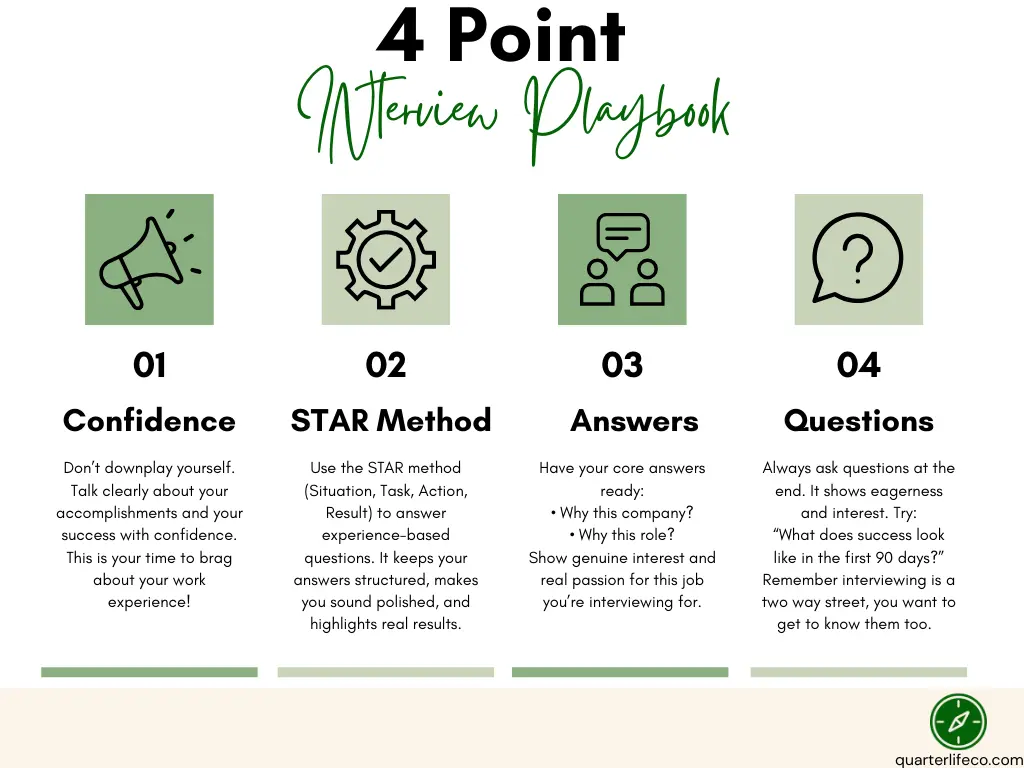
Advice #1: Don’t Be Humble
The company interviewing you doesn’t want to hear about the great project the team did. They’re hiring YOU, not the TEAM. Talk about your accomplishments, your aspirations, what you hope to achieve in your potential new role with them. They want to hear about you.
Advice #2: Come Prepared with STAR Method Stories
Interviewers want to see you answer their questions in this format. If you’re not familiar with it, this is Situation, Task, Action, Results. The most important part is results. At the end of the day, companies want to see results, and showing them clear examples of when you’ve achieved results will shine through.
Advice #3: Have Answers To Common Questions Ready
Almost every interview will ask why this company, why this role. Companies want to know you really want to work for them and do this job specifically. When I got to the interview stage of my sales roles, I found it very easy to move forward because my passion for sales was obvious. Unlike in my engineering interviews where it was more difficult for me to summon that passion. So also try and have a genuine passion for the job and company you’re interviewing with.
Bonus: How To Answer the “Biggest Weakness” Question
Another common question is “what’s your biggest weakness?” The key to answering this is to pick a weakness that has nothing to do with the success in that role, and show how you’ve worked to improve the weakness.
Here’s the play for this question. Say you’re interviewing for a coding position.
Interview: “What’s your biggest weakness?”
You: “I would say my biggest weakness is my writing skills. But I’ve really wanted to get better at this so the past 3 months I’ve committed to reading at least 30 minutes everyday, and writing for 15 minutes everyday as well. From this I’ve seen my writing skills significantly improve.”
Analyzing this response, you can see that by answering with something like writing skills, which isn’t really important for most coding positions, as well as showing how you’re improving that weakness (shows proactiveness) is the recipe for successfully answering this common question.
Don’t be the person who says your biggest weakness is being a perfectionist. That is sure to get an eye roll and shows lack of honesty and authenticity.
Advice #4: Always Ask Questions at the End
Companies want to know you’re interested in working for them. After all, hiring is one of the most costly decisions for a company. If it doesn’t work out, they lose out big time. So with that being said, ask great questions at the end to show you care and want to succeed in the role. An easy crowd pleaser is “What does success look like in this role during the first 90 days?”
The 3 Biggest Mistakes New Grads Make When Job Hunting
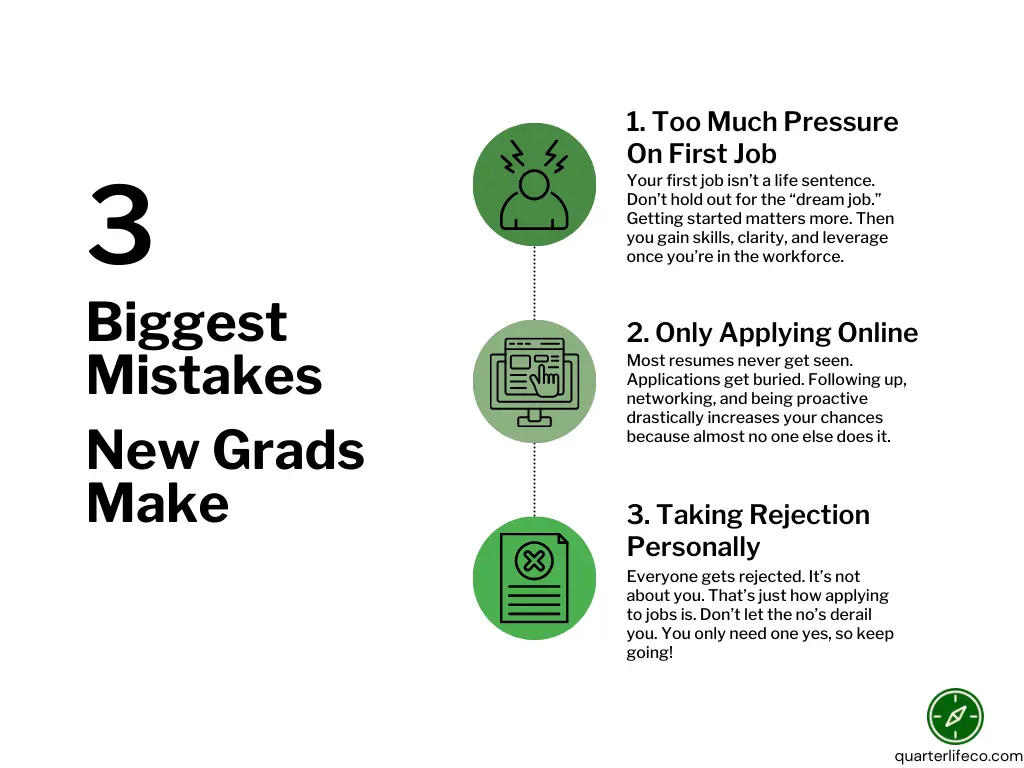
Mistake #1: Treating the First Job Like a Life Sentence
Being too picky can lead to delaying your career start, which can have detrimental effects like less future career earnings and job stability. So instead of trying to find that dream job, find a job that aligns somewhat with what you want to do and go from there. You’ll learn a lot about yourself and what you want out a job through that experience. You have less flexibility with being picky about your first job out of college, since you don’t have much leverage yet.
Mistake #2: Only Applying Online and Never Following Up
I saw firsthand how chaotic hiring for a new role is when an old company I worked for was looking for a new tech sales person. The hundreds of applications, the reading of resumes, the interviews and prepping for them. It’s so easy for applications to lost in the shuffle. It makes sense why most resumes don’t get read, it’s virtually impossible to do so. But following up and being proactive with your application to a company drastically increases the odds you’ll be in the mind of the hiring manager, for the simple fact that most applicants don’t do this.
Mistake #3: Taking Rejection Personally
Getting rejected in a part of life and is especially true when looking for your first job out of college. It’s easy to take these rejections personally and let it phase you, thinking you’ll never get a job. But you have to ignore those feelings and keep pushing. After all, you only need one yes in the constant sea of no’s.
Also, don’t take it personally. Everyone gets rejected during their job search. You’re not alone in that feeling.
Conclusion: You Only Need One Yes
Finding your first job out of college is one of the most overwhelming and humbling experiences you’ll have as a young adult. It feels like your entire future hinges on this outcome.
But hopefully through this playbook you realize two things.
Number one is that your first job out of college is not the rest of your life. It’s only the start. It’s the tutorial round that gives you confidence, skills, and momentum to tackle the workforce the way you want to. And gives you critical skills for choosing your next career move.
Number two, the age of cold applying online and hoping to get a job is dead. Competition is fierce. More people have college degrees than ever. What will set you apart is putting your face in front of recruiters and hiring managers, developing relationships, and being relentless with the career you want.
You only need one yes to land that first job out college. Go find that yes!
📌 Summary
- 🎓 Why Your First Job Is So Hard to Get
Finding your first job is the hardest because you have limited experience and little leverage, making companies hesitant to take a risk on you. Rejection is totally normal and not a reflection of your worth.
- 💭 The Dream Job Fallacy
The first time around, the goal isn’t to find your dream job. You likely don’t know what your “dream job” is yet, and that’s okay. Your first job is meant to teach you what you like, what you hate, and what direction to take next.
- 🚫 Don’t Only Cold Apply
Cold applying rarely works anymore. Most jobs are filled through referrals, recruiter outreach, and intentional networking. Not by submitting applications into a void.
- 🧠 4 Myths Holding Back Your Mindset
GPA, school prestige, and your major matter far less than you think. These myths keep new grads stuck when employers care more about skills, reliability, and results.
- 🎯 The Playbook for Interviewing
Interviews are your chance to prove why you’re the right hire. Come prepared with strong STAR stories, clear results, confident communication, and thoughtful questions that show you’re invested in the role.
- ⚠️ 3 Biggest Mistakes New Grads Make
Being too picky, only applying online, and taking rejection personally can stall your entire career. Avoid these traps to build momentum and land your first real opportunity.
Article FAQ
Most new grads take 3-6 months to land their first job. It’s normal. The timeline depends on your field, how actively you network, and how prepared you are for interviews. This is also why it’s best to start applying months before you graduate, so you have a job lined after college.
Only a few competitive companies filter by GPA. After you graduate, most recruiters barely look at it. Experience, skills, results, and how you interview matter far more.
It’s 100% networking. Around 80% of roles are filled through connections, referrals, and recruiter outreach.
Rejection is a normal part of the job application process, not a sign you’re not qualified. Hiring managers reject hundreds of applicants simply due to volume, timing, or fit. Just keep pushing. Remember, you only need one yes.
Not the end of the world. No one, especially with you being in your 20s and it being in your first job, expects you to stay at that job forever. Use it as a stepping stone and learning experience, and guarantee you’ll be able to use that perspective to land a job that’s a better fit.