Introduction: Why This Breakup Feels Different
The first adult breakup of your 20s carries a different sting than in your teenage or even college years. It’s not the kind where you cry for a week and move on, but rather it makes you question your whole identity. Who you are, what you want, and how something that you were certain was going somewhere could disintegrate so fast.
You start to think about your timeline. After having invested important years of your 20s into a relationship that didn’t work out, regrets and sadness begin to surface. For the life you thought you would have with that person, and for the time you’ll never get back. Learn more about dating in your 20s with our article “7 Things No One Tells You About Dating in Your 20s.”
At Quarter Life Co., we understand how much these adult breakups can suck. This guide was created to help you make sense of that first adult breakup of your 20s. Why does it hurt so much and ways that you can heal. So you can move on and live life in your 20s fully. Not stuck on a past relationship.
Why Adult Breakups Hurt Different Than Teen or College Heartbreak
The Stakes Are Higher Now
I’m not trying to say that breakups in your earlier years didn’t sting, they definitely did. In fact, I’ve been there. It feels like with that first heartbreak, you’re the messiest you’ve ever felt. But adult heartbreak hits on a different level, because the stakes are so much higher.
During your teens and early college years, romantic relationships include a lot of emotional discovery. It can be super intense and exciting but most of the time it’s hard to see the whole future with someone during it. Here you learn what love can feel like, but you’re not at a place yet in your life where it requires insane sacrifice.
Identity Formation in Your 20s
Serious adult relationships hit so different, partly because the stakes are higher. That what makes the first adult breakup of your 20s feel so different. You have emotional interdependence and shared dreams for the future. To top it off, in your 20s you’re already juggling identity, career, and uncertainty. Having a stabilizing force like a relationship end exacerbates insecurities and anxieties about the uncertain future that plagues our 20s brains.
The Pressure of the Timeline
There’s also an (unfair) pressure that relationships ending in your 20s means it’ll be harder to find someone to settle with in the future, since you’re getting “older”. With that relationship that ended at 19, at least you have many years ahead of you to find the one. But that relationship that ended at 28 after 3 years together feels like wasted time you’ll never get back, with a louder clock ticking to find a life long partner. The timeline in your 20s becomes tighter, which means every breakup carries more weight.
Fewer Distractions as an Adult
Lastly, as an adult there’s less distractions from the breakup, which makes it so much harder. Unlike high school or college where there were constant parties, new people to meet, friends, and activities, as an adult life still goes on. You have to go to work, pay your bills, and hold yourself together while going through this inner turmoil. With the first adult breakup of your 20s, you’re usually without sufficient distractions to ease your mind.
The Psychology Behind Heartbreak: What’s Really Happening in Your Brain
Your Brain Doesn’t Know the Difference Between Physical and Emotional Pain
So why do breakups feel so painful? Bluntly, it’s because your brain doesn’t know the difference between a broken heart and a broken bone. Of course the science here doesn’t only apply to the first adult breakup of your 20s. Teenagers and college students experience these same brain changes. But still, knowing this universal experience makes it easier to understand why you’re feeling the way you do.
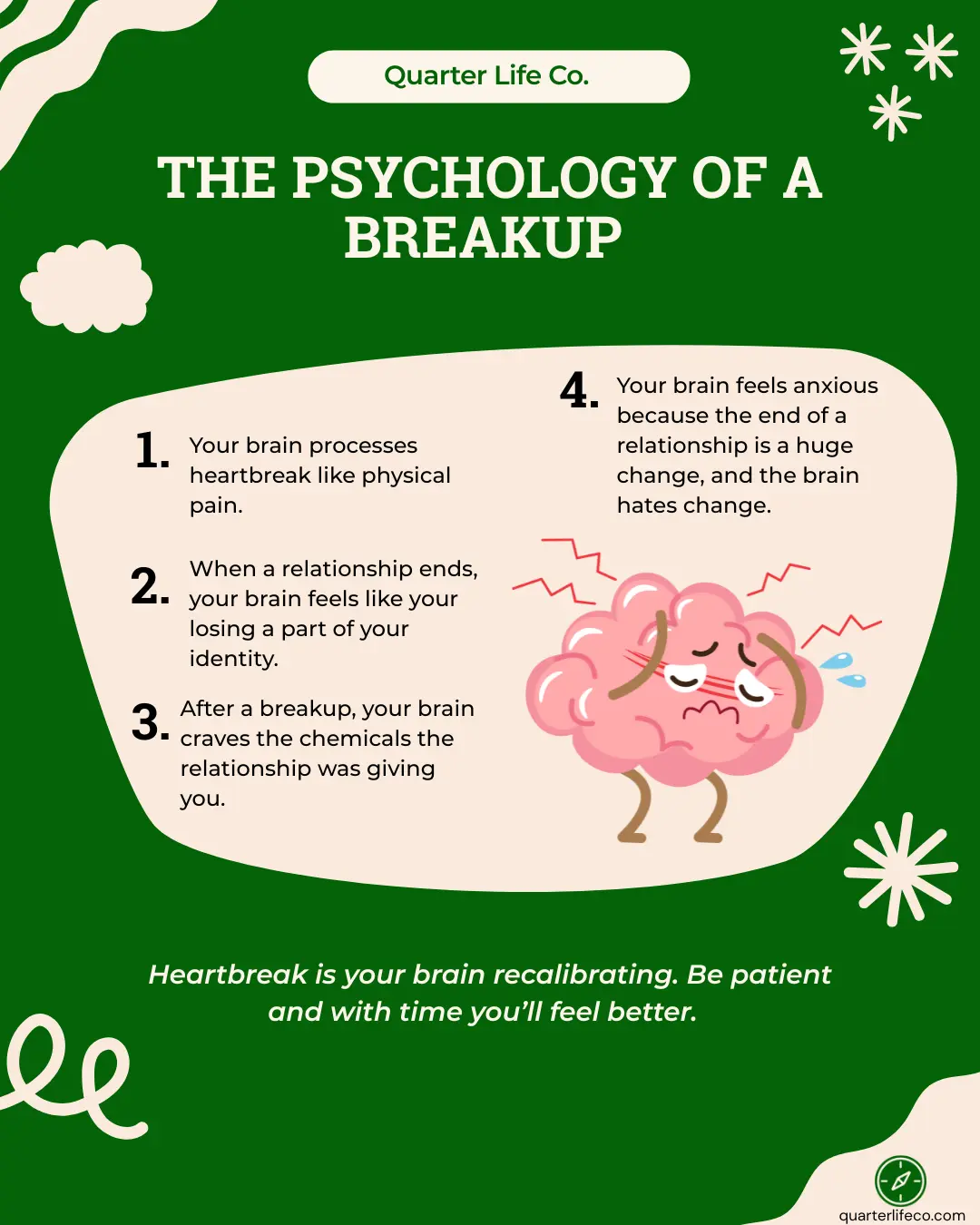
When you go through a breakup, the same parts of your brain that light up during physical pain (specifically the anterior cingulate cortex and insula) activate. It’s physiologically painful. MRI studies even show that heartbreak triggers the same neural pathways as being physically hurt. So your brain interprets a breakup as a kind of invisible injury, which makes it all the more frustrating.
Love and Attachment Are Wired Into Our Biology
Relationships, especially romantic ones, are such a core part of our biology. At its foundation, the human species is a social and attachment-driven creature. Love, connection, and belonging aren’t just “nice to haves” they’re survival references. So when a relationship ends, your brain is treating it as a threat to your safety.
Psychologically, adult romantic partners become attachment figures, a lot like parents are to children. Your romantic partner is your emotional safety base. When that bond breaks, your amygdala (the fear and panic center of your brain) goes into overdrive stressing that it’s lost an important source of safety. That’s where the anxious feelings come from after a breakup. Your brain feels that it’s been abandoned and is reacting accordingly.
You’re Going Through Chemical Withdrawal
Falling in love and developing a deep relationship with someone floods your system with dopamine (reward) and oxytocin (bonding). Those chemicals make the bond you have with that person addictive and magical. The trade-off though is when you breakup, those neurochemicals plummet. You then have drug withdrawals like an addict who’s trying to quit cold turkey.
That’s why you try to get your “fix” by stalking their social media, replaying memories in your head, and looking at old photos.
The “No Contact” Rule Is The Best Detox
This is why the “no contact” rule is best for not just the first adult breakup of your 20s, but after a breakup at any point in your life. It’s cutting off the drug supply your brain was getting from this relationship, so you can detox and reset your brain. But you can’t fully reset if you keep taking small doses of this drug, like looking at old photos or just having a “quick” conversation with your ex.
Your Brain Hates Change
Predictability is way more comfortable for us as humans. That’s why even if a partner treated you terribly, you still grieve the end of the relationship because your brain prefers the negative predictable experience over the uncertain change. Going through a breakup destroys your mental homeostasis, and your mind clings to the past relationship because it’s familiar, and the unknown future without that previous partner is scary.
How To Get Over Your First Adult Breakup of Your 20s
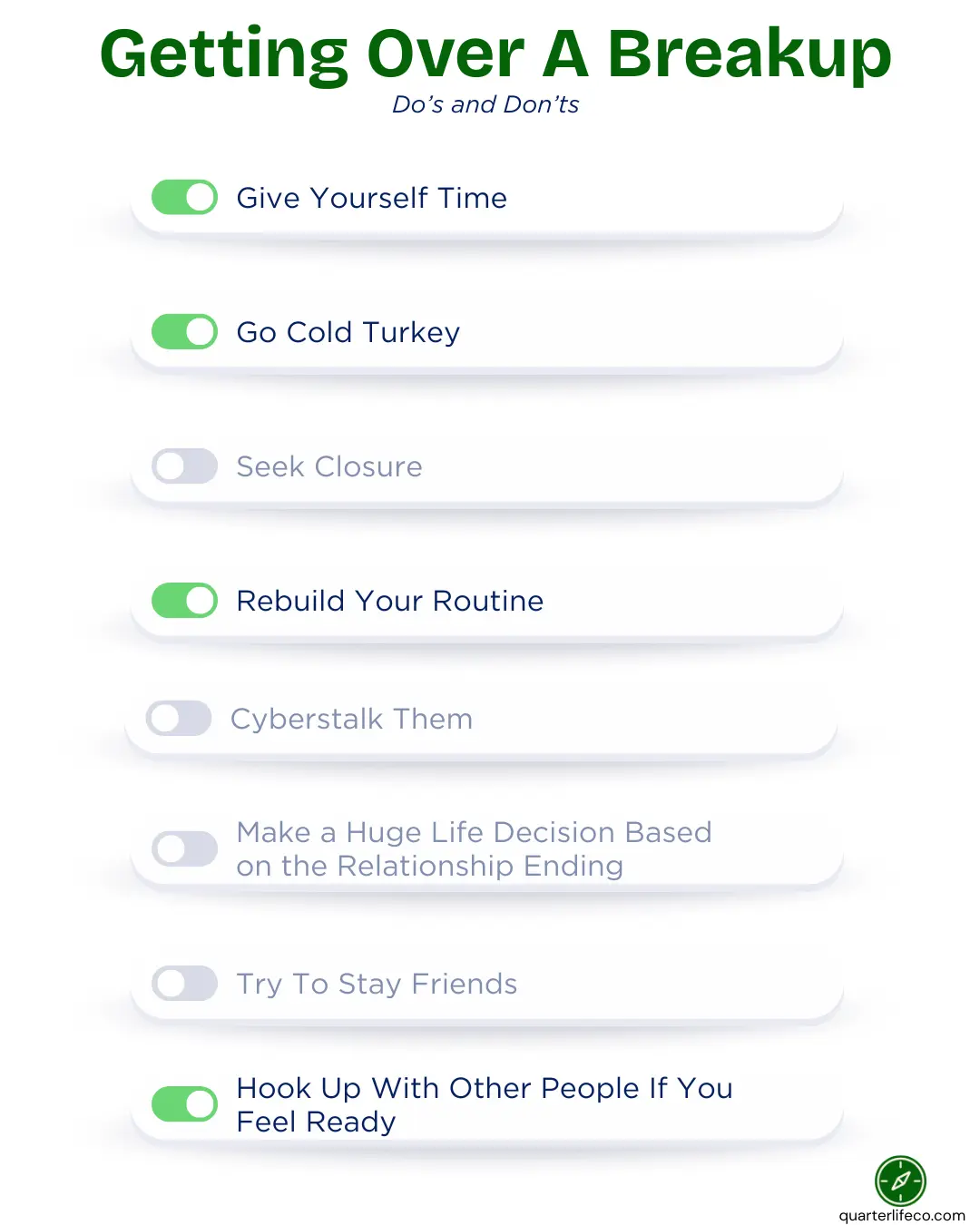
Give Yourself Time
You’re going through withdrawals right now. The only thing that can help the withdrawals is time. With more time, you will get used to not having that person in your life, and so will your brain. Right now you’re crashing out but don’t do anything rash or emotional. Just let yourself heal.
Go Cold Turkey
Talking with your ex again just resets the dopamine clock. Going cold turkey also includes not looking at old photos or stalking their social media, because that just keeps the dopamine loop alive. Every text, call, or social media story of theirs you watch gives your brain another dopamine hit that thrusts you back into the cycle.
So what you have to do is get aggressive. Archive and hide old photo memories you have with them. Unfollow them on social media. Even go so far as to delete old chat threads with them, because I know you’re looking through those at 2 am in the morning.
Rebuild Your Routine
Now you probably have way more “you” time than you’re used to. Fill this space by doing things that will distract you from the breakup as you let time do its healing. Like:
- Gym Routine: Moving your body helps your brain release those chemicals it was once getting from the relationship.
- Make plans with friends: You likely pulled away a bit from friends when you were wrapped in the bubble of the relationship. Now reinvest again in those friends. Connection with others will serve as a great substitute for the romantic connection with your ex that you’re craving
- Revive your hobbies: Become you again. Sometimes in relationships we forego things we love for lack of time or energy, but now you likely have way more of both now that you’re out the relationship
About Hooking Up With Other People
I’m not going to gloss over this method of getting over someone. We all think about it. Should I “get over someone by getting under someone else.”
I don’t feel that there’s anything wrong with sleeping with other people as a way to get over someone. When going through a breakup, sometimes your confidence takes a massive hit. Hooking up can remind you that you’re still attractive, charismatic, and wanted in some form.
But don’t confuse the validation hooking up will give you for healing. Those are two totally different things. For the pain you’re going through after your breakup, time and no contact is the cure, and hooking up is just a band-aid.
What Not To Do After a Breakup
Don’t Seek Closure
Closure is a myth. You don’t need some final talk or apology, you just want an excuse to get your dopamine hit by talking to them.
Closure will come when you give yourself time to heal, not from some magical words they might say. Anyway, what do you really think they are going to say to you that will make you feel so much better anyway?
I remember I tried to get closure from my ex months after we broke up. I was chilling, living my life, and doing fine. But we ended up bumping into each other 8 months after we ended things and decided to get lunch the next day. I don’t know why I felt the need to talk to her, but I mistakenly thought it would be a final nail in the coffin so I could fully move on.
Well that was a huge mistake. We talked, she told me about some flings she had, I tried to share mine to counteract what she just told me. We talked about where we were in life. And it was just pointless. Then to top it off I basically took a giant leap back in regards to getting over her and spent the next two months like I had just broken up with her. Overall a 0/10 experience. Would not recommend.
Don’t Cyberstalking Them.
Like I wrote earlier. Looking at old photos and their social media profile gives your body these mini dopamine hits that don’t allow you to fully detox. You need to unfollow their social media profiles. Delete old chats. Even unfollow their close friend’s social media profiles.
Likely they know you’ll be looking at their social media, so they’re going to curate it in a way that they want you to see it. You’re watching their highlight reel that’s designed to make them look fine while you’re struggling in your bed crying at 2:00am in the morning.
Don’t Make a Huge Life Decision Just To Cope
Sure, you can go ahead and die your hair blue if that’s the crazy thing you want to do. But don’t quit your job, move cities, or (and this has happened) crash your car into a tree to try to make your ex feel guilty. Right now, your emotions are extremely high, it’s important not to make any rash decisions and instead process your emotions and give them time.
If you make any crazy decisions now, you’ll likely regret them soon since they were made in the heat of the moment.
Don’t Try to Stay Friends
This rarely is a smart decision, especially right after. You really just want to stay friends so you can still keep in contact and keep getting your dopamine hits. I’ve never understood that logic. How can you just flip a switch and become friends with someone you have romantic history with. Maybe once you’re fully detached months after, but even then what’s the point of that. There’s so many potential friends out there in this world. You don’t need to recycle your ex into a friend.
Conclusion: It’ll Get Better
Getting over your first adult breakup in your 20s is a process. One you probably haven’t been through yet. But hopefully this guide sheds light on how to move forward from it.
With getting over an ex, the most important rule is the no contact rule. Like we discussed through much of this article, the strong emotional reactions you’re experiencing are because of withdrawals you’re having from that person. With the no contact rule, you allow time to do the healing so you can come out of the post breakup depression stronger and ready for your next phase of life.
It’ll take time, but one day you won’t feel the pain from this breakup like you’re experiencing now. Just be patient, be composed, and lean into your emotions. Eventually you’ll laugh again, flirt again, and even find someone new.
❤️🩹 Summary
- 🧭 Why Adult Breakups Hurt So Much More
Adult breakups hit harder because the stakes are higher. Shared futures, identity formation, and fewer distractions make breakup in this decade uniquely painful.
- 🧠 The Psychology Behind It
Heartbreak activates the same brain regions as physical pain. There’s science behind love withdrawal, dopamine crashes, and why no contact works.
- 💊 How to Get Over It
Heal from your first adult breakup by giving yourself time, going no contact, rebuilding your routine, and rediscovering yourself.
- 🚫 What Not to Do After a Breakup
Don’t chase closure, stalk your ex, or make impulsive choices. The healing comes with time, you just need to be patient.
Article FAQ
Everyone’s healing timeline is different, but most people start feeling significantly better after 3–6 months of no contact. However, the deeper the attachment, usually the longer it takes to get over them. At the end of the day you need time and distance away from them, which will expedite the healing process.
Ughhhh please don’t! You only want to do this so you can get that dopamine hit from talking to them, but it’s only going to make you feel worse after. Closure comes from you giving yourself time and reflection away from that person, not from some magical thing you think your ex will say to you.
100% yes. The “no contact” rule is an emotional detox from all the chemicals that you were being flooded with during the relationship. This rule doesn’t just include not talking to your ex though. Every scroll, old chat, or story you look at gives you brain a small dopamine hit that keeps you hooked. So don’t forget to mute your ex on social media as part of the “no contact” process.
Rebuild your routine with the gym, friends, hobbies, and work. Physical activity and social outings will help boost confidence and is a great substitute for the chemicals your ex was giving you. Also, sometimes hooking up with other people isn’t the worst thing to do after a breakup. If you end of not liking it, you can always wait to pursue dating until you’re more ready.
Yes you will. Right now you’re in the thick of it. Your brain is rewiring itself after emotional separation. But over time and with distance this strong negative feeling will fade. It’s just hard to see that when it hurts so bad right now.