Why Making Friends in Your 20s Feels So Hard
You just moved to a new city. Your old friends are in different time zones. You’re home on a Friday night watching a movie alone. Familiar?
For most of your life, friendships were effortless. School, dorms, sports teams and clubs guaranteed you were surrounded by people your age almost every day. What you’re figuring out now though, is that adulthood flips that experience on its head. Friends move to new cities, schedules get packed, people’s priorities shift, and sadly, sometimes you just drift apart from old friends.
The truth is that having strong relationships is one of the biggest drivers of happiness, according to the World Economic Forum. But in your 20s, building them seems like an impossible task. Without those built-in environments, you now have to figure it out on your own. But don’t worry. This guide will show you exactly how to make friends in your 20s.
Shift your Mindset: Avoid These Common Mistakes
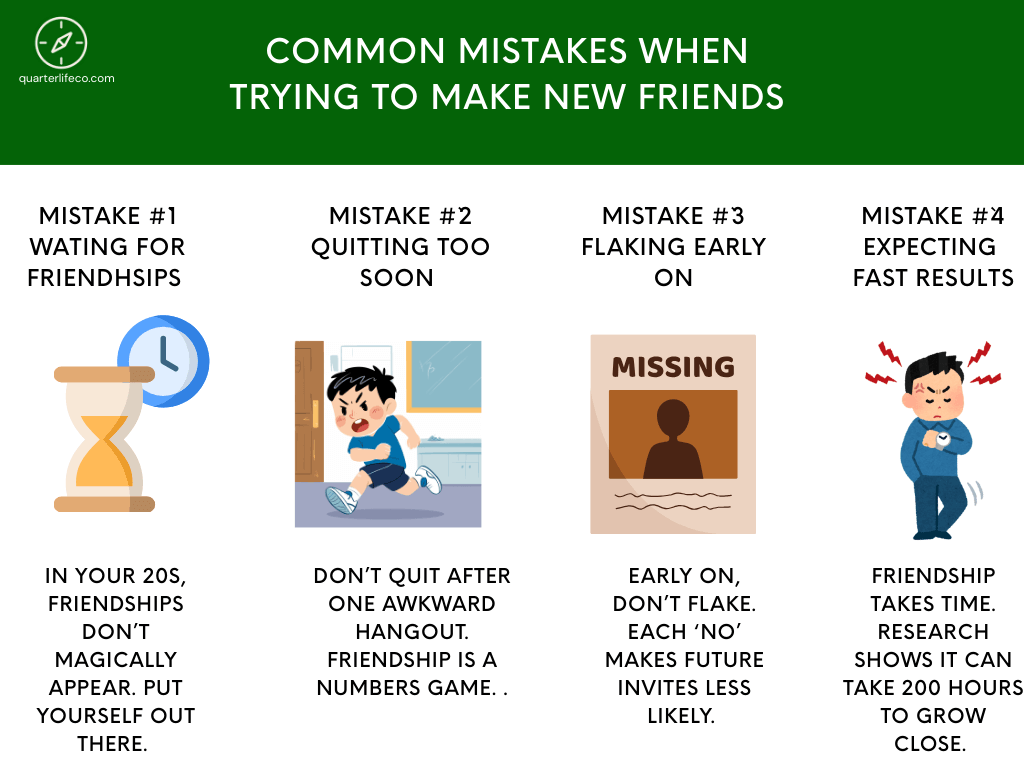
Mistake #1: Waiting For Friendships
In school, friendships formed naturally through constant exposure, but learning how to make friends in your 20s means realizing those built-in environments are gone. This means if you’re waiting for friendships to come to you, you’ll be waiting a long time. You have to go on the offensive and put yourself out there to meet new people. Look beyond only work or bars. Join a sports league, volunteer group, or class you’re interested in. The more you put yourself out there, especially in environments with repeated interactions, the greater your chances of forming genuine connections.
Mistake #2: Quitting Too Soon
Know that you won’t click with everyone and some people flat out won’t like you. That’s life. But if you stop trying after one awkward hangout or cold reception, you’re not giving yourself the opportunity to meet those connections that would have worked. Making friends is a numbers game. The more people you meet, the more chances you have to find the ones who you click with. Push through the discomfort, there’s gold on the other side.
Mistake #3: Flaking Early On
In the early stages of building friendship, every last-minute cancellation or “no” to an invite chips away at your chances of being invited again. People don’t like the feeling of rejection, so each decline makes you less likely to hear from them the next time. Commit 100% at the start, attending every event you can. Once the friendship is established you can ease up. But doing so too soon means you’ll likely get removed from the invite list entirely.
Mistake #4: Expecting Fast Results
In school, friendships formed fast because you saw each other every day. As an adult, that constant exposure disappears and the progression of friendship takes much longer. Research by psychologist Jeffrey Hall from the University of Kansas shows it takes 50 hours of exposure to move from acquaintance to casual friend, 90 hours for a real friend, and 200 hours for a close friend. That’s why being patient matters. It’s the price of real connection.
The 4 Pillars of Building Lasting Friendships
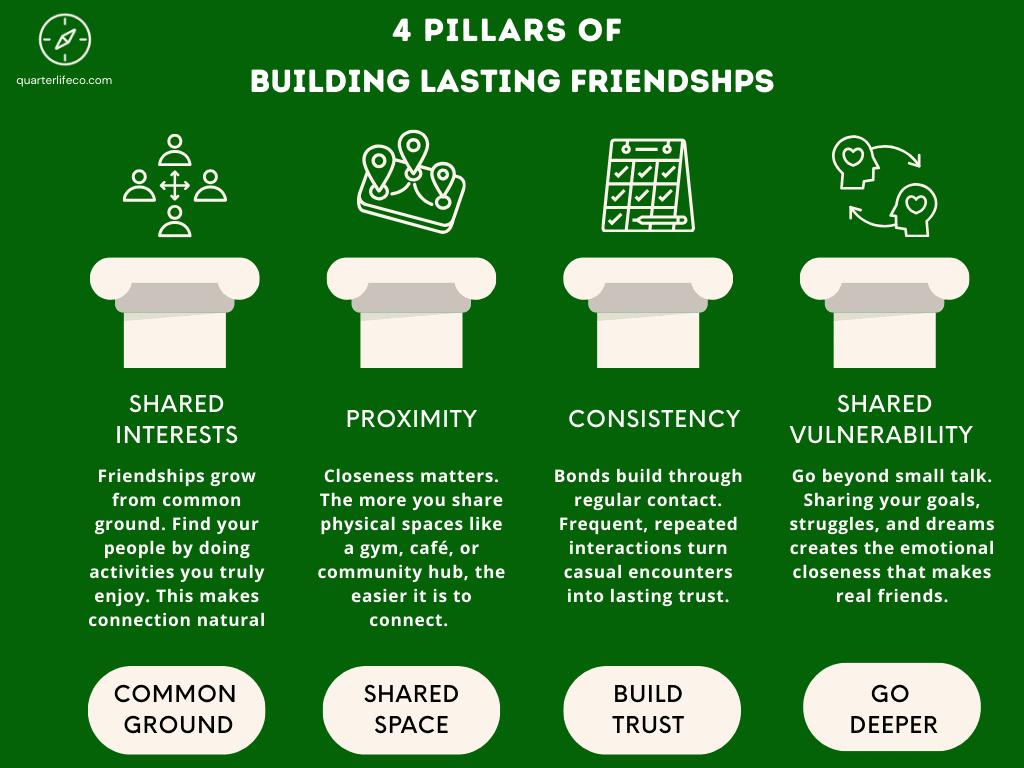
There are four pillars for how to make friends in your 20s, backed by social science research. They are shared interests, proximity, consistency, and shared vulnerability. Understand these and you’ll have the blueprint for creating meaningful, long-term connections.
Pillar #1: Shared Interests
Common ground makes friendships easier to form and maintain. This is backed by the “similarity attraction effect,” which shows we naturally gravitate toward people who share our hobbies, values or passions. That’s why it’s important to be in environments where you’re likely to meet people like you. If you’re not into partying, a nightclub isn’t the best place to look for friends.
Action: Identify clubs, groups, or activities you would enjoy and that would attract like-minded people. Shared interests create an instant foundation for a budding friendship.
Pillar #2: Proximity
The closer and more accessible someone is, the easier it is to build a connection. Distance is one of the biggest barriers to friendship. Shared spaces like a local gym, coffee shop or community center can make those casual interactions turn into real relationships because you can show up consistently.
Action: Choose one go-to spot that’s close and attracts the same type of people. Proximity creates consistency, which leads into our next point.
Pillar #3: Consistency
Regular contact is what turns casual encounters into lasting friendships. Weekly hangouts, recurring events, or even quick chats build familiarity and trust over time. Even if you click instantly with someone, without consistency the bond will fade.
Action: Commit to showing up at your chosen spot at least once a week. As psychologist Jeffrey Hall found, you need those 200 hours of time together to go from acquaintance to close friend. Consistency is how you reach that number.
Pillar #4: Shared Vulnerability
Small talk is the doorway, but deeper conservations build real friendship. Opening up about your stories, challenges, and dreams fosters trust and emotional closeness. Don’t share everything in the first meeting, but over time incorporate more depth into your conversations with people.
Action: Begin with light conversation, then intentionally share more personal insights over time. Your future goals are an easy one to share. This vulnerability invites others to do the same, turning surface level connections into lasting bonds.
Best Places to Meet New Friends in Your 20s
Now that you know what not to do, it’s time to put yourself in the right environments to meet people. If you’re figuring out how make friends in your 20s, the key is to focus on spaces where you’ll see the same faces regularly and on activities you genuinely enjoy.This increases your chances of meeting people you’ll connect with.
Space #1: Hobbies
Choose activities you already enjoy, but do them in a group setting. Join the rec soccer team, sign up for a dance class, or try that new cooking workshop you’ve been eyeing. Having a built-in activity takes the pressure off conversation, letting connections form naturally. Pick something recurring so you see the same faces often. That’s how casual acquaintances turn into real friends.
Space #2: Online Communities
Platforms like Meetup.com (hobby-based events), Bumble BFF (one-on-one connections), and Facebook groups (community-specific meetups) make it easy to find people who share your interests. When I moved to Tampa after college knowing no one, I joined a bar crawl through Meetup. That one night turned into a circle of friends I still talk to years later.

Space #3: Volunteering or Community Projects
Volunteering is a great way to meet people who share your values. You can walk dogs at an animal shelter, help out at a food bank, or join a local beach clean-up. You’ll be surrounded by people who care about the same causes you do. Shared work creates instant camaraderie and the friendships often last longer than the project itself.
Space #4: The “Third Place”
Find a spot that isn’t home or work where you can casually show up. Something like a neighborhood café, climbing gym or board game shop. Think Central Perk from Friends. When you become a regular, you start seeing the same faces, and those small, repeated interactions can naturally grow into friendships.
Space #5: Existing Connections
Reconnect with old friends, former classmates or past coworkers who live in your city. Invite them for coffee or lunch. Even if you’re not super close, they might introduce you to their friends, expanding your social circle. Friend-of-a-friend connections are one of the best paths to growing your social life.
How to Make Friends in Your 20s if You’re Introverted or Socially Anxious
If you’re introverted or socially anxious, learning how to make friends in your 20s starts with removing the pressure of big, overwhelming events. One-on-one meetups or small groups are gold. Try apps like Bumble BFF or look for Meetup.com events with only a few RSVPs. To take the edge off even more, choose activities like hiking or trivia so you’re not under pressure to talk nonstop. You can also pick a casual event where there’s alcohol if it helps you relax. The secret is to combine fewer people with a built-in activity, so the focus isn’t all on conversation. Recurring activities are especially key. Introverts often warm up slowly, so doing the same class or meetup overtime gives you a chance to build comfort and familiarity.
A One Month Roadmap for Making Friends in Your 20s
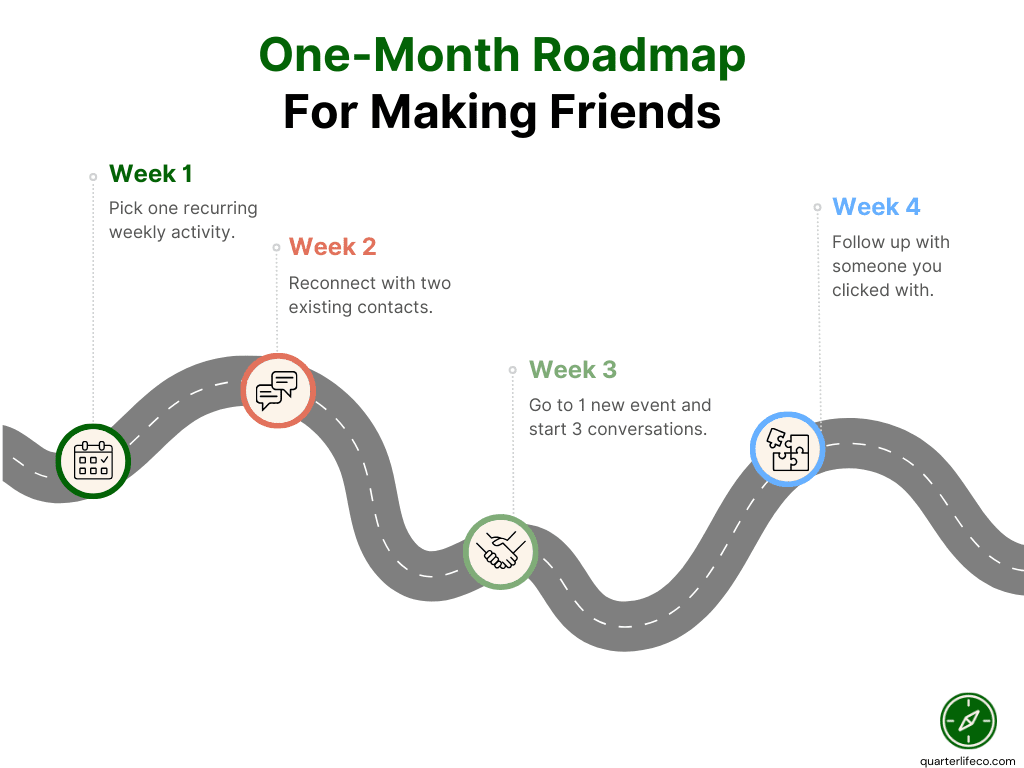
Here’s a one month roadmap for how to make friends in your 20s that actually works, I’ve used it myself. It might feel uncomfortable at first but if you stick with this, you’ll open up doors to friendship.
Week #1: Lock in Your Recurring Activity
Pick one weekly activity for this month. Choose something you’ll actually enjoy like a rec sports league, church group or night class. Keep it close to home or work so there’s no excuse to skip. Lastly, commit to showing up for at least 4 weeks straight. Remember, consistency is how you build relationships.
Week #2: Reconnect with 2 Existing Contacts
Scroll through your social media or phone contacts and find two people in your city you haven’t seen in a while. Send a casual message like, “Hey I’m in town. Want to grab coffee or lunch?”. Even if they say no, you put yourself on their radar. They might invite you to something down the road. If you know absolutely no one locally, call a close friend or family member. A quick does of social connection will give you the momentum to tackle the rest of this month’s challenge.
Week #3: Go to One New Event & Start 3 Conversations
Pick a networking night, Meetup group or community event where the purpose is to meet new people. Your only goal: start three conversation. Keep it simple, “Hey I’m [Name], what’s your name?” Most people are there for the same reason as you are and just as nervous. The first “hello” is the hardest but once you break the ice, the conservation usually flows. After all, that’s why everyone showed up, to meet people.
Week #4: Follow Up With Someone You Clicked With
Reach out to someone you connected with at your weekly activity or recent event. Take the lead and suggest something specific like, “Hey, want to check out that new restaurant?” Most people never follow up, so this small effort makes you memorable and makes the person feel special. That first step often snowballs into a real friendship.
Conclusion: Quality Over Quantity
You only have so much social energy, so invest in friends who truly add value to your life. In your 20s, it’s tempting to try and be friends with everyone, but prioritizing quality over quantity will give you deeper, more fulfilling connections. Psychologist Robin Dunbar’s research shows we can only maintain about 150 social connections at once, and many of those aren’t even close friends. That’s why it’s better to focus on depth, not just numbers and it’s why this guide urges you to put yourself out there. You’ll only find the people you truly click with by meeting plenty you don’t. Look for green flags in a budding friendships like shared interests, reliability, matched effort, mutual respect, and a genuine two-way connection. Once you master how to make friends in your 20s, you stop chasing every potential connection and start building a circle that makes your life feel full, exciting, and rich.
🤝 Summary
- 👥 Friendships take effort in your 20s. Gone are the built-in school and dorm connections. You need to be intentional.
- ❌ Avoid common mistakes: waiting for friends to come to you, quitting too soon, flaking, or expecting instant closeness.
- 🏛️ Follow the 4 pillars: shared interests, proximity, consistency, and vulnerability.
- 📍 Best places to meet people: hobbies, online apps, volunteering, “third places” like cafés, and reconnecting with old contacts.
- 😌 Introvert? Start small: one-on-one meetups, small groups, or activity-based events to ease pressure.
- 📅 Try the 1-month blueprint: weekly activity, reconnect with 2 contacts, attend one new event, and follow up with someone new.
- 💚 Focus on quality over quantity: look for green flags like effort, reliability, and mutual respect.
Article FAQ
Not at all. During your 20s, you actually come to know yourself more which gives you a greater advantage in pursuing relationships you align with. Some of my best friends I made after college!
That’s completely normally, don’t take it as an ego hit. Romantically how many people do you truly click with? The same applies to friendships. You’re not going to click with everyone but for you to meet people you will click with, you need to put yourself out there and play the numbers game.
This is dependent of the person, but you should feel blessed with even 2 to 3 close friends. This can be a strong support system as you navigate your 20s.
This is extremely common. Many friendships are built on proximity. And in your 20s people constantly move for new opportunities. This lessens the exposure you have to those friends. You also change a lot in your 20s and friendships that once served you might not align with who you are as a person anymore.
Research shows it takes around 200 hours together to go from acquaintance to close friend. That’s why consistency and patience are crucial to devleoping deep friendships.