Cleanser, vitamin C, retinol, you can keep going with the amount of skincare products that are out there. After all, the global skincare market is a multi-billion dollar industry. But NO product out there is more important than sunscreen. You may not see the effects of the sun on your skin in your 20s, but 80% of skin aging is caused by sun exposure. Protecting your skin early means better skin in your 30s, 40s, and beyond,
What does sunscreen do?
Think of the sun’s rays like a sword and sunscreen as a very effective shield. The sun gives off two different, very powerful rays called UVA rays and UVB rays. We’ll cover these later, but for now you should know that over time these rays can contribute to premature aging and increased skin cancer risk, among other things.
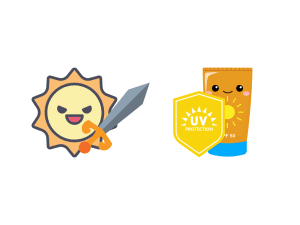
There’s two types of sunscreen:
The first is sunscreen that reflects UV rays. These are your mineral/physical sunscreen that contain ingredients like zinc oxide and titanium dioxide.
The second is sunscreen that absorbs UV rays and transform them into harmless heat before they can damage your skin. These are what we call chemical sunscreens that contain ingredients like avobenzone or octinoxate.
At the end of the day, what sunscreen does is shield you from the sun’s harmful rays, but it’s not 100% protection which we’ll get into later.
UVA and UVB rays
The sun’s ray contains both UVA and UVB rays, but they’re not present in equal amounts. Approximately 95% of the UV radiation that reaches the Earth’s surface is UVA, while the remaining 5% is UVB. In short, almost all UV rays you get exposed to are UVA! Let’s dive deep into the difference between the two rays.
Let’s start with UVB rays. UVB rays are what cause that ever popular sunburn and redness when you have a long beach day. They mostly affect the top layers of skin. These rays directly damage skin cell DNA, lead to most skin cancers and are strongest midday between 10am to 4pm, and in the summer. What’s nice about UVB rays is that they can’t pass through glass so if you’re inside with the windows shut, you’re protected from them!
Now onto UVA rays. They penetrate deep into the dermis layer of the skin. They are the main cause of premature aging: think wrinkles, sagging, sunspots, discoloration, etc. UVA rays have a longer wavelength, and because of that they can pass through glass and clouds extremely well. They are present all day and all year, with relatively constant intensity compared to UVB. That’s what makes them so dangerous. Unlike UVB they won’t show up as visible damage like a sunburn after a few hours, but 9am on a cloudy December winter, they are present and over time can contribute significantly to premature aging. That’s why when you’re outside, it’s important to wear sunscreen, no matter what the weather looks like!
SPF and Broad-Spectrum
You see SPF 15, SPF 30, SPF 50, even SPF 100, but what does that really mean?
SPF rating only takes into account UVB rays. It stands for Sun Protection Factor and technically measures how much longer it takes skin to burn with sunscreen compared to without it. But what really matters is the percentage of UVB rays it blocks, which is shown in the table below.
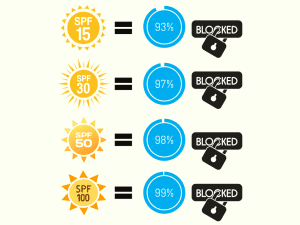
This is why it’s said sunscreen isn’t 100% effective, but it’s pretty darn close. You can see that as long as you have SPF 50, you are pretty well protected. There’s no need to stress about that 1% increase in UVB protection. What’s more important is that the sunscreen is broad-spectrum. SPF is only a measure of protection from UVB rays, so you’ll want broad spectrum to prevent against the UVA aging rays as well.
Not all broad spectrum sunscreens protect from UVA the same way. Broad spectrum means that the sunscreen blocks UVB rays based on its SPF and an “appropriate amount” of UVA rays, but what does this really mean? In the U.S., the rules around broad spectrum sunscreen are less strict. The sunscreen has to pass what’s called a critical wavelength test (wavelength is >370nm), but the catch is the test doesn’t measure how strong the UVA protection is or what exact percentage of UVA rays are blocked. This is because the U.S. FDA doesn’t require UVA protection to be quantified like with SPF for UVB. A super rough estimate could be 60-80% coverage from UVA rays but even then it would change based on the exact sunscreen being used.
But there’s hope for certainty. If your broad spectrum sunscreen contains a high percentage of zinc oxide (18-25%), then you at least have coverage from 90-95% of UVA rays!
Better yet, go foreign. Sunscreens in Europe, Japan and Korea have significantly stricter regulations when it comes to UVA protection.
In Europe, sunscreen must provide UVA protection that is 1/3 of the labeled SPF. So in Europe if you buy SPF 30, the UVA protection must be at least 10, which means 90% of UVA rays are being blocked.
In the Asian countries mentioned, they use a PA rating system which measures UVA protection. The levels vary from PA+ to PA++++ which offers extremely high UVA protection, over 95%.
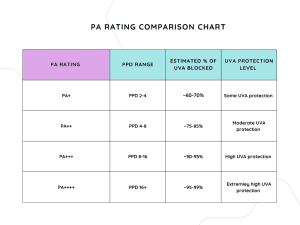
These high standards coupled with added UVA filters (like Mexoryl and Tinosorb) make these types of sunscreen a safe choice to protect you from the aging rays of UVA, in addition to UVB rays.
Want some sunscreen recs? In the European market, La Roche-Posay Anthelios UVMune 400 Invisible Fluid SPF50+ is a great choice.
UV Effect on Different Skin Colors
Our skin color comes from melanin which is a natural pigment produced by skin cells. Melanin does provide SOME protection against UV rays, but it’s still important to wear sunscreen no matter your skin color! Many people with more melanin believe they don’t need sunscreen because they rarely burn, but you still need daily sun protection and here’s why…
- UVA rays: Melanin offers less protection from the aging rays of UVA, which can contribute to the breaking down of collagen causing premature aging, sagging and fine lines.
- Hyperpigmentation and Dark Spots: Darker skin is more prone to hyperpigmentation, especially from things like acne or injuries. Unprotected sun exposure makes these marks darker and harder to fade.
- Sunspots: The sun can still cause you to develop sunspots and discolored patches over time, resulting in uneven melanin skin distribution.
- Skin Cancer Risk: While skin cancer is less common in darker skin, it is still possible and even worse, in darker skinned individuals it is diagnosed at a more advanced, dangerous stage when it does happen.
With that being said, individuals with lighter skin have much less of a natural UV defense. This means they are more susceptible to burning from UVB rays, signs of aging (wrinkles, sunspots) and skin cancer, so of course sunscreen is a must for them as well.
The table below is inspired by the Fitzpatrick Scale, a classification system used to categorize skin types based on how they respond to UV sun exposure. We’ve also added a natural SPF estimate and skin cancer risk to the table.
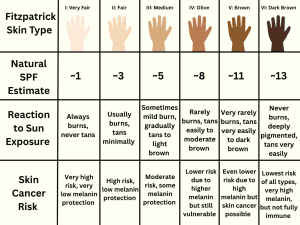
Australia: A Case Study
Australia has the highest rates of skin cancer in the world. Close to 2 out of 3 Australians will be diagnosed with some form of skin cancer during their lifetime. That’s an absurd number. So what’s some of the reasons for this?
- High UV Radation: Australia experiences very high UV radiation levels because of its proximity to the equator, clear skies and thinner ozone layer.
- Predominantly fair-skinned population: Many Australians descend from Europeans who have fair skin that evolved in low-UV regions. When placed in the brutal Australian sun, their skin burns easier and is more vulnerable to UV damage and thus skin cancer.
- Outdoor lifestyle: Australia has some of the most stunning natural landscapes and a diverse range of outdoor activities. But this increased time in the sun leads to increased skin cancer risk.
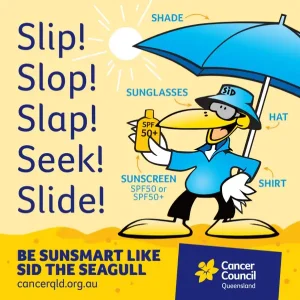
Australia offers a poignant tale of the dangers of unprotected sun exposure. But good news! Recognizing their skin cancer problem, Australia launched public health campaigns like “Slip, Slop, Slap, Seek, Slide” to encourage people to protect themselves from the sun, increasing the use of sunscreen among their population, which has resulted in skin cancer rates starting to stabilize among younger Australians.
Quik Math
Let’s do a math problem to highlight the effectiveness and need for sunscreen.
Sandra lives in Quito, Ecuador. Quito is essentially on the equator, at a high altitude of 2,800 meters and many clear sky days. Because of this, Quito experiences UV levels ranging from 14 to 19 which is classified as EXTREMELY high, among the highest in the world.
Jack lives in Seattle, Washington. It’s overcast a lot of days, it’s much farther from the equator and the city is a meagre 53 meters above sea level. So, the UV index is an average of 3, significantly less than Quito.
Because she knows how dangerous her sun is, Sandra reapplies broad-spectrum sunscreen with at least 90% blockage of UVA and 98% blockage (SPF 50) of UVB to her face and body EVERY 2 hours during the day. Jack doesn’t bother with sunscreen. After all, the sun isn’t even strong where he lives, right? Wrong choice Jack.
Let’s look at the table below to highlight the differences in their UV exposure over a 10-year period. The table assumes that both Jack and Sandra spend about 14 hours per week outdoors, totaling approximately 7,410 hours over 10 years. By multiplying this by the average UV index, we can estimate their total UV dose over that time. Since roughly 95% of UV rays are UVA and 5% are UVB, we break down those cumulative UV hours accordingly. Finally, to estimate the actual UV exposure reaching their skin, we factor in the sunscreen’s effectiveness. This assumes 90% protection against UVA and 98% against UVB.
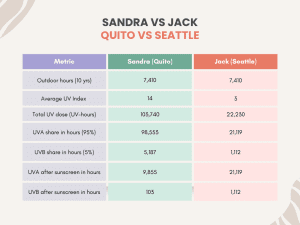
Crazy results right?! Sandra lives in a place with close to 5x the UV index of Jack, her exposure is almost 5x more throughout the ten years, yet her total UVA and UVB exposure is 2x and 10x less respectively. And this is all just from wearing sunscreen. It doesn’t even take into account other factors like wearing a hat, sunglasses, UV clothing and avoiding peak UV index hours. This example highlights the strength of sunscreen and how important it is. Even someone like Jack who lives in a low UV index zone could still benefit from a sunscreen routine.
How To Apply Sunscreen
Applying sunscreen correctly is crucial to getting the maximum protection.
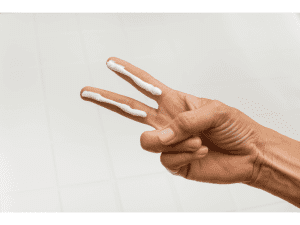
Step 1: For your face and neck, apply two finger lengths of sunscreen as shown in the picture below. For your body, you’ll need much more, the size of a golf ball but it’s best to use cheaper sunscreen for this. Make sure to cover all exposed skin and remember the forgotten areas: Ears, neck, back of hands, tops of feet and bald spots.
Step 2: After applying, wait 15-30 minutes before going in the sun, to allow the sunscreen to set.
Step 3: Reapply every two hours, or immediately after swimming, sweating, or towel drying, since sunscreen’s effectiveness can decrease significantly under these conditions.
Article FAQ
UVA rays cause aging and long-term skin damage, while UVB rays cause sunburns. Make sure to use a sunscreen that protects effectively against both.
The recommended reapplication time cycle is every two hours, or more often if swimming or sweating, to maintain full protection.
That’s not true! Everyone needs sunscreen as no one is immune from the effects of the sun. While darker skin individuals are more protected, it’s not 100% protection and sunscreen helps prevent long-term skin damage and skin cancer for all skin types.
You can also use UV-rated clothing, hats, sunglasses and seek shade during peak sun hours (10 am – 4 pm), in addition to the most important protection, sunscreen.
Broad spectrum means that the sunscreen protects against both UVB and UVA rays. However, it’s important to note that not all broad spectrum sunscreens protect the same. For UVB protection, the SPF on the sunscreen will show you the level of protection but for UVA, look for sunscreen with a PA++++ for maximum UVA protection.
Yes! Up to 80% of UV rays can penetrate through clouds, so you can still get significant sun exposure even on cloudy days!
As long as you have SPF 50, which is 98% protection, you’re protected enough. The more important thing is that you wear the sunscreen and reapply when needed. No need to stress about going all the way to SPF 100, which is a mere 1% increase of 99% protection.