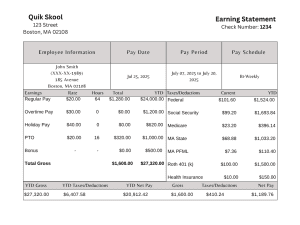
Pay stubs can be confusing. They have a lot of information on them about something so important, your money! Using the example template below, we’re going to teach you how to read a paystub so you can understand all the details, section by section.
Part 1: Employer Header Section
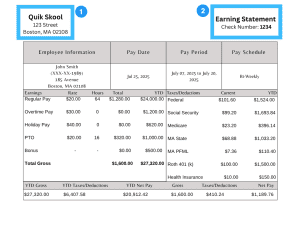
The first part is the employer header section at the top. This includes…
- Employer Information: The name of your employer and the employer’s address
- Pay Stub Identification: This includes the title of the document and the document number for recording keeping purposes. Note that the title of the document can have other names such as pay stub, pay slip, wage statement, et
Part 2: Employee & Pay Details Information
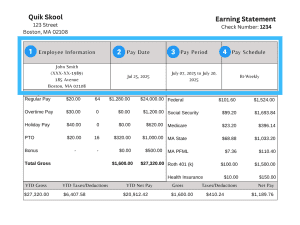
The second part includes employee and pay details information. This highlights who the receiver of this pay stub is and the time information about the payment.
- Employee Information: This includes the employee’s name, their social security number (partially masked only showing the last four digits for privacy) and the address of the employee.
- Pay Date: The date on which the employee is paid. In other words, when they actually receive their direct deposit/check.
- Pay Period: This refers to the exact work dates that this payment applies to.
- Pay Schedule: Denotes the schedule of payment. This one is bi-weekly, but could also be weekly, semi-monthly, monthly, etc.
Part 3: Earnings Section
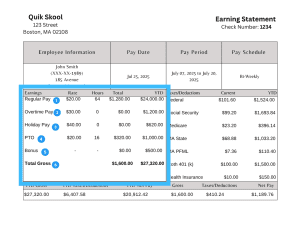
Part 3 is the earnings section which is a breakdown of your total amount of money for the pay period before taxes and deductions.
In this example, each line shows the number of hours worked and the hourly pay rate. However, this applies primarily to hourly employees. If you’re salaried, the “Hours” and “Rate” fields may be blank, show dashes, or simply reflect a flat pay amount — since your pay doesn’t change based on hours worked.
You’ll also notice the YTD (Year to Date) section. This is the total amount of that type of pay you’ve received in the calendar year.
- Regular Pay: This is the standard wage you’ll receive for the pay period. For hourly employees, you can see the hourly rate and hours worked which multiplied together translates to the total amount.
- Overtime Pay: If hourly, you would get a different pay rate if you work more than 40 hours in a week. This is typically paid at 1.5x the regular hourly rate.
- Holiday Pay: While not required, some companies will have a different pay rate for holidays if you work that day. For example, if you end up working Christmas, you could be paid at a higher rate for working that day, but again this is not required by law.
- PTO: This stands for paid time off. In other words, you took time off but still got paid as if you had worked.
- Bonus: This could be any incentive or performance-based additional compensation. There is no hourly rate attached to this.
- Total Gross Pay: Finally, this is the total of all earnings before any taxes or deductions are taken out. You can see the total for this pay period as well as the YTD for the calendar year.
There could be other earnings not covered in this section like commissions or reimbursement (like for work travel). Those would follow the same structure as the “Bonus” section.
Part 4: Taxes & Deductions Section
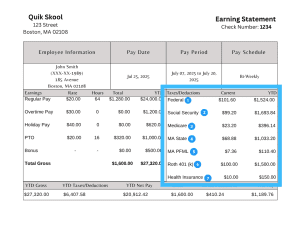
Part 4 is the taxes and deductions section. This lists the amounts taken out of your gross pay before you receive your net (take-home) pay.
We’ll start with lines 1 to 5. These are the mandatory taxes required by law.
- Federal: These are taxes to the United States federal government. Taken by the IRS, this amount is based on your earnings, filing status and W-4 information. This number may or may not be accurate and thus during tax season you might get a refund or have to pay additional taxes.
- Social Security Tax: Funds the U.S. Social Security program and is usually 6.2% of your wages. This program funds the retirement, disability, and survivorship benefits that millions of Americans receive.
- Medicare: Funds Medicare and is usually 1.45% of your wages. Medicare is a federal health insurance program for people age 65 or older and younger people with certain disabilities.
- State Income Tax: This is taken by your state government based on state tax rules. Some states don’t have state income tax so if you’re in a state like that, you wouldn’t pay this!
- PFML: This stands for Paid Family and Medical Leave. Is a tax some states have that helps fund paid time off for medical or family related leave, like caring for a new child or a sick relative.
Lines 6 to 7 are voluntary or other deductions. These aren’t taxes but rather for deductions like for your health insurance and retirement, just to name a few.
- 401k: This shows your retirement plan contributions. A Traditional 401(k) is funded with pre-tax income, lowering your taxable earnings, while a Roth 401(k) is funded after taxes and grows tax-free. Your pay stub will clearly label which type you’re contributing to, based on which one you chose earlier.
- Health Insurance: Your employer usually covers part of your health insurance cost, and you pay the rest. For example, if your plan costs $160 per pay period and your company pays $150, you’ll pay the remaining $10. That $10 will show up as a deduction on your pay stub.
Note that there could be other deductions like dental insurance, vision insurance, union dues, etc. That will follow the same format as lines 6 and 7.
Part 5: Net Pay & Year-to-Date (YTD) Summary Section
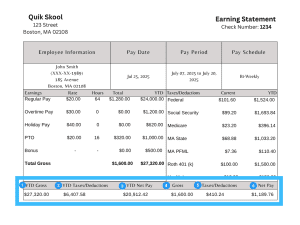
This section shows the final take home pay after all the deductions. It always shows what taxes/deductions are being taken out for this paycheck, and what has been taken out the whole year.
- YTD Gross: This is the total amount of money you’ve earned in the calendar year so far, BEFORE taxes/deductions.
- YTD Taxes/Deductions: This is the combined total of taxes withheld from your paycheck and those voluntary deductions we discussed.
- YTD Net Pay: This is the total take home pay for the calendar year after taxes/deductions.
- Gross: This is your total pay BEFORE taxes for this specific paycheck.
- Taxes/Deductions: This is the total amount of taxes/deductions for this specific paycheck.
- Net Pay: The most important line item. This is the total pay you take home for this paycheck after taxes/deductions.