You hop in your car, try to turn on the engine, but all you hear is clicking. The car doesn’t start! You likely got a dead battery. Dead batteries can happen for a number of reasons. Maybe a light in the car was left overnight or maybe the cold winter weather weakened its charge. You’ll have to jump start the battery, and Quik Skool has you covered on how to do that!
Step 1: Setup
You’ll need…
- Jumper Cables
- A helpful friend (or stranger) with a working car battery
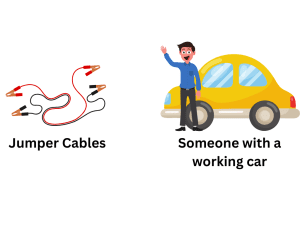
In a SAFE location, set up the car with the dead battery nose to nose with the car that is going to assist with the jumpstart, about 18 inches apart. Make sure both cars are in park, the emergency brakes are on, and the engines are off.
Step 2: Open Hood of Car and Locate the Batteries
Open the hoods of both cars and locate the batteries. Look for a rectangular box with two thick cables and two posts sticking out (the posts are where you connect the jumper cables). Make sure the batteries are free from corrosion. If there’s corrosion, wipe it off.
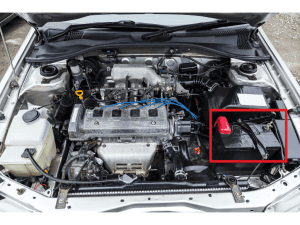
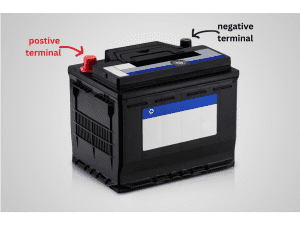
Next, identify the positive terminal on the battery. This will be denoted by a plus sign, a red color or both.
Then, identify the negative terminal on the battery. This will be denoted by a negative sign, a black color or both.
Step 3: Connect the Jumper Cables
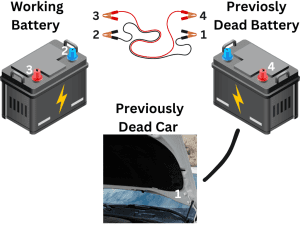
In this EXACT order, connect the jumper cables.
- Attach one red clamp to the positive (+) terminal of the dead battery.
- Attach the other red clamp to the positive (+) terminal of the working battery.
- Attach one black clamp to the negative (−) terminal of the working battery.
- Attach the other black clamp to a bare metal surface on the engine block or frame of the dead car, away from the battery. (This grounds the circuit safely.)
IMPORTANT: Make sure you do part 4 correctly. Never connect the black clamp to the negative terminal of the dead battery as that could cause sparking.
Step 4: Start the working car
Wait 3 minutes after connecting the jumper cables. Then, start the engine of the working car, letting it run 3 minutes.
Step 5: Start the dead car
After the car has run for those 3 minutes, try to start the dead car. This is done while the working car is still running and connected through the jumper cables. If it doesn’t start, wait another minute or two and try again. Once it starts, leave both cars running for a few minutes so the charge stabilizes.
If the car still doesn’t start after a couple of tries, the battery may be completely dead or a part of the electrical system might be faulty. In this case, you’ll need a mechanic to take a look at the car.
Step 6: Disconnect the Jumper Cables
While both cars are still running, disconnect the jumper cables in the reverse order you placed them.
- Remove the black clamp from the ground on the previously dead car.
- Remove the black clamp from the working battery.
- Remove the red clamp from the working battery.
Remove the red clamp from the previously dead car.
Step 7: Recharging the car
Let the previously dead car run for at least 15 minutes by driving it around or idling. This allows the battery to fully recharge so that when you turn the car off, you don’t have another dead battery again.
Rehash
- Setup
Most important is to park in a safe location before you attempt to jump star your battery. Next, get your jumper cables and have your working car nose to nose with the dead battery for easy jumper cable connection.
- Open Hood of the Car and Locate the Battery
Open the hood of both your cars and find the positive and negative terminals on both batteries.
- Connect the Jumper Cables
Make sure to connect the jumper cables in the correct order. First is red clamp to dead battery’s positive terminal. Second is red clamp to working battery’s positive terminal. Third is black clamp to good battery’s negative terminal. Fourth is black clamp to an unpainted metal surface on the dead car, to act as a ground.
- Start the Working Car
Turn on the car with the good battery and let it run for 2-5 minutes.
- Start the Dead Car
Try to start the car with the dead battery. If it works, let both cars run for 5 minutes.
- Disconnect the Jumper Cables
With both cars on, remove the jumper cables in the reverse order you put them on. First is to remove the black clamp from the unpainted metal surface on the dead car. Second is removing the black clamp from the good battery’s negative terminal. Third is removing the red clamp from the working battery’s positive terminal. Fourth is removing the red clamp from the dead battery’s positive terminal.
- Recharge the Car
Let the jumped car run for 15-30 minutes by either driving it around or leaving it running. This ensures that the battery fully recharges and you won’t have to jump it again due to a lack of sufficient energy.
Article FAQ
Connecting the black cable to the dead battery’s negative post could cause sparks near the battery, which may lead to an explosion or fire because of the gases being released.
First check for corrosion on the battery terminals which you can wipe off or signs of a cracked or leaking battery. For the former, you can usually clean on the corrosion with a rag and for the former, a jump star won’t work and you’ll need to fully replace the battery.
No! Never touch the metal ends of the jumper cables together as that could cause sparking and short circuiting which could be very dangerous.
Let the working car run after being connected to the dead car for 2-5 minutes. This gives time for the dead battery to recharge.
To safely jump a car, you must connect in the following order. First is red clamp to the dead battery’s positive terminal. Second is red clamp to the working battery’s positive terminal. Third is black clamp to the working battery’s negative terminal. Fourth is black clamp to an unpainted metal surface on the dead car (don’t connect this to the dead battery!).
Yes jump starting a car the wrong way can damage your vehicle. Reversing the cable order or crossing terminals can cause malfunctions like electrical shorts and battery explosions. The way to avoid this is simple, always follow the correct connection sequence of the jumper cables and never let the cable clamps touch.