If you’re in your 20s and wondering how to start investing, you’re not alone. According to a survey by TIAA, 80% of Gen Z are not saving for retirement, with the leading reason being that they don’t know where to start.
The investing community is ripe with complicated processes, different advice, and people trying to sell you courses. This guide will cut through all of that. The process of investing for retirement in your 20s is way simpler than you’ve been led to believe. In this guide we’ll show you step by step how to open a retirement account and start investing, in less than 15 min. We’ll also share why it’s so important to start investing in your 20s. Look at the top regrets of older people from their 20s, and one of the most common is not financially preparing for retirement. This guide will make sure you don’t have that same regret.
The Power of Compound Interest in Your 20s
“Compound interest is the eight wonder of the world” – Albert Einstein
Before we get into the steps, let’s talk about why it’s so crucial to start investing in your 20s. Think of this hypothetical situation. Anna is 25 years old when she starts investing. Mike is 35 years old when he starts and Jen is 45 years old when she starts. For all of them, their goal is to retire at 65 years old. Anna puts in $500 a month for 40 years. To catch up on retirement, Mike puts $666.67 a month for 30 years and Jen puts in $1000 a month for 20 years. This means, that by the time they’re 65, they all would have contributed $240,000 to their retirement. Let’s also say that they all invest in an ETF that tracks the US stock market, which has historically given a 10% rate of return per year. Look at the table below to see what their retirement portfolio looks like when they’re 65.
| Name | Amount |
|---|---|
| Anna | $2,775,174.07 |
| Mike | $1,375,235.75 |
| Jen | $718,259.23 |
Mind blowing right?! All put the same money towards retirement, Anna just started earlier. The lesson is, money invested in your 20s is so much more powerful because of compound interest. Of course, it’s hard to invest money if you’re struggling to pay expenses in general, but try and at least contribute something to your retirement every month. Future you will thank you!
With that being said, even if you’re past 25 and haven’t invested, don’t fret! Mike and Jen still have a decent sized portfolio even though they contributed later. “The best time to plant a tree was 20 years ago. The second best time is now.” – Chinese Proverb
It’s important to know the difference between saving and investing though. Saving is for shorter term goals like paying for a wedding, saving for a down payment on a house; 1-5 year goals. Saving eats away at the value of your money because of inflation every year. To combat that, you turn to investing for longer term goals that are 5+ years. Things like investing for retirement or investing to pay for your young child’s college tuition.
Step 1: Open a Retirement Brokerage Account
A brokerage account allows you to buy and sell different investments like stocks, bonds, mutual funds and ETFs. Think of it like an online market. You’ll want to pick a brokerage account that has commission-free trading, aka no fees. This allows you to keep more of your money! Below are the top brokerage accounts to chose from.
1 Fidelity: https://www.fidelity.com/
2 Vanguard: https://investor.vanguard.com/home
3 Charles Schwab: https://www.schwab.com/
If you’re struggling to pick one from these three, go with Vanguard. They have $0 trading fees, a simple interface, and solid long-term investment options. Once you select which brokerage company you’re going to use, go through the steps on their website of opening an account.

Step 2: Choose Where to Allocate Your Investments
There’s different investment vehicles you can use as a place to invest your money, and some have great tax advantages. Examples include Roth 401K, Traditional Roth IRA, Traditional IRA and HSA just to name a few. It can get overwhelming, so I’m going to give you an order of where to invest your money, one through five. This is not highly applicable to everyone because there are other factors like how much income you have and time until retirement, but in your 20s, with a long time horizon for investing, this is the best order.
1. Start with Your 401(k) Employer Match
If your employer offers a 401K match, this should be the first investment vehicle you take advantage of. Note this might be through a separate brokerage account than you opened up in step 1, since your employer chooses the provider. Still, this is a good vehicle to take advantage of. Why? This is free money from your employer. How a 401K employer match works is that your employer will match up to a certain percentage of the money you contribute to your own 401K. For example, if your employer match is 3%, and your salary is $100,000 a year, if you contribute $3000 (3%) to your 401K for the year, your employer will give you an additional $3000 for your 401K. So then you’ll have a total of $6000 contributed to your 401K for that calendar year. If you contribute $4000, you’re employer would still only give you the 3% match of your salary ($3000).
You have two options for this, a Roth 401K and a Traditional 401K. Contributions to a Roth 401K are made after tax, whereas contributions to a Traditional 401K are made pre tax. When deciding which one to contribute to, take into account how much money you’d like to pull out in retirement. Say you’re looking to pull out around $70,000 in retirement per year and currently make $50,000 per year. Then pick the Roth 401K since your tax burden is likely less than it’ll be in retirement. With people in their 20s, it’s advised to go with the Roth option. This is because in your 20s you typically make less than you will in the future, so you’re tax burden right now is the lowest it’ll ever be. Take advantage of that by paying taxes on your money now, so you don’t have to later.
2. Max Out a Roth IRA or Traditional IRA
After meeting the employer match, the next vehicle to invest through is an IRA. Like the logic above, based on your income, you can choose between contributing to a Roth or Traditional IRA. Unlike a 401K through your employer, with an IRA, you have more investment options and have control over which brokerage account you use which is why it’s suggested to max out an IRA as the second step. The current limit for your IRA in 2024 is $7000 for those under age 50, and $8000 for those age 50 or older. An IRA can easily be opened up through the brokerage account you selected in step 1.
3. Contribute More to Your 401(k) (Beyond the Match)
You’ve already met the employer match for your 401K, now it’s time to max it out. The tax advantages of a 401K make it extremely beneficial. You can either do a traditional 401K and your money will grow tax deferred or you can pick a Roth 401K and not have to pay taxes when you take money out of it for retirement. As of 2024, the 401K limit for the year is $23,000.
4. Use a Health Savings Account (HSA) If Eligible
A HSA is for money you would put for future health related expenses. The beauty of the HSA is that it has great tax benefits. Your contributions are tax deductible, your money grows tax deferred and you can withdraw money tax free as long as it’s used to pay for qualified medical expenses. To be eligible for an HSA, you must be covered under a qualified high deductible health plan. You can check this by talking to your health insurance agent. As of 2024, current contributions limits are $4,150 for self only coverage and $8300 for family coverage. If your situation requires better coverage than a high deductible health care plan, then get better coverage! That is more important and will likely be more economical since you’d pay less towards meeting your deductible.
5. Invest in a Taxable Brokerage Account Last
If you have extra money to invest and have already maxed options 1 through 4, then you can put money in a regular taxable investment account through the brokerage account you made in step 1. Note this doesn’t have tax advantages. You pay tax on the money you put in the account, and when you take the money out, you pay taxes on the money gained through investing. The positive is there’s no penalties for taking out your money before retirement age, as is that case with the 401k and IRAs.
Step 3: Decide What to Invest In and Why Most People Don’t Beat the Market
It’s tempting to become a day trader. Picking stocks that are going to give you 1000% returns! I’m here to tell you that it’s extremely tough to beat the market. It requires you investing a lot of time into learning how to pick stocks, and more so, a lot of luck. Even then, studies show that professionals whose job it is to manage money and multiply their client’s portfolio’s, FAIL to beat the market the majority of the time.
Matthew McConaughey said it best in his cameo in the Wolf of Wall Street, “Nobody knows if the stock is gonna go up, down, sideways or in circles…it’s all a fugazi.”
So what do you invest in if you can’t beat the market? Well, invest in the market!
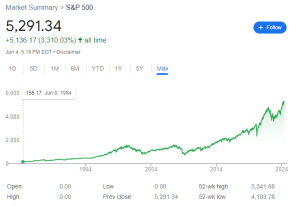
When I say the market, I refer to the US Stock Market. See below an example of a stock that follows the market, the S&P 500. This is a collection of the 500 largest companies listed on the stock exchange in the United States. You can see the long term growth as a whole, with dips in certain years occasionally, but long term the stock value grows. This is how you build wealth long term, beat inflation and grow your money, passively.
Why VTI Is a Strong Long-Term Pick
You can’t directly invest in something like the S&P 500 since it’s just a performance metric of the stocks it contains, but the brokerage accounts I listed have their own ways to invest that track the performance of something like the S&P 500. These can be mutual funds, exchange traded funds or index funds. In this guide, I’m going to stress ETFs (exchange traded funds) as the primary investment for retirement because of its diversified market exposure. In the context of a Vanguard brokerage account there’s so many choices of what to invest in. Since this is guide is made for simple investing, I’ll give the optimal ETF choice for investing for retirement.
Invest most of your money in VTI
VTI tracks the whole US stock market, thus diversifying your portfolio all in one investment vehicle, while still maintaining about a 10% annual rate of return. I’m not saying VTI should be the only investment you carry, as there’s other great stocks and ETFs like VUG (tracks growth stocks so great if you’re younger and want higher risk, higher return), VOO (tracks the S&P 500 shown above), and VXUS (tracks the international market for global exposure), but VTI should be a core part of your investment portfolio if you want consistent returns over the long term until retirement. ETFs like VTI, VUG, VOO, and VXUS are among the best retirement investments because they offer automatic diversification, growth, and low fees in one place. At the end of the day, you want diversification since the stock market is so unpredictable. An ETF gives you that diversification.
Step 4: Decide How Much to Invest
The 20s can be tough financially. Everyone is at different stages on their money journey, and some have more to invest than others. A common sentiment I hear is that “I wouldn’t be able to save much money so what’s the point.” Don’t adhere to the mindset that just because you only have a little bit of money, it means you have to wait to invest. The general rule out there is saving 20% of your income, but just investing any amount you can is beneficial. If you’re wondering how to start investing for retirement, the most important thing is to just get started. Small, consistent steps can grow into serious wealth over time.
Let’s do another hypothetical situation. Richard is 30 years old. He had a lot of odd jobs through his 20s and wasn’t able to save much, but he did invest $50 a month into VTI for the whole of his 20s. That’s 10 years where he invested $7200. Say he doesn’t invest a single penny again. With that $50 per month he invested in his 20s, when he’s 65 at retirement, that amount would have ballooned to $280,000. Crazy right?! That’s why there’s no such thing as “too little” when it comes to investing for retirement. With being in your 20s and the power of compound interest, over time, that “little” money snowballs into something extremely substantial.
FAQs About Retirement Investing
The best way is to open a brokerage account and start investing in a tax-advantaged account like a 401(k) or IRA. Specifically invest in low cost index funds like VTI and most importantly, invest consistently.
You can start with as little as $5. Don’t wait to have “enough money”, just start! Once you have the investment systems in place, it’ll be much easier to invest in your future as your income grows. Also, you’ll be surprised how fast any amount of money can grow with compound interest.
Both are great, but if your employer offers a 401(k) match, start investing there. This is free money that your employer is giving you so take advantage of it! Once you’ve contributed up to the match, you can invest in your IRA which also has tax advantages.
A traditional IRA gives you a tax deduction now, but you pay taxes when you withdraw later. A Roth IRA uses after-tax money now, but your withdrawals in retirement are tax-free. If you expect to be in a higher tax bracket during retirement, a Roth IRA is usually better.
The answer is yes as all investing involves risk. But not investing is also risky. Every day you don’t invest, inflation is slowly eating away at your money’s value. Retirement accounts are meant to be long term investments. There will be short term dips but long term, if you stick with diversified options like ETFs, your money grows.
How to Start Investing for Retirement in 4 Simple Steps
Learn how to start investing for retirement in four simple steps, even if you’re starting with just $5.
- Open a brokerage account
Choose a platform like Vanguard, Fidelity, or Schwab.
- Choose where to allocate investments
Prioritize the 401(k) match, then max out your IRA.
- Pick what to invest in
Start with diversified ETFs like VTI.
- Decide how much to invest
Start with any amount you have!
Final Thoughts on How to Start Investing for Retirement
If you’ve taken anything from this guide, the #1 thing is to understand that your 20s are the most powerful time to start investing for retirement. You don’t need to be a Wall Street trader or use fancy algorithms to pick the next Bitcoin. All you need is to start early, be consistent, and diversify through ETFs. Follow these steps and you’ll no longer be overwhelmed with how to start investing for retirement, you’ll be doing it and setting yourself up for the future you want! You got this. Let’s go get that MONEY!